
Managing commissions in credit intermediation is not simply a matter of confirming an amount at the end of a case. Each remuneration must be linked to the correct case, its status must be followed and the team needs enough information to work without uncertainty.
When this management depends on several spreadsheets, emails and notes, it becomes harder to understand what is expected, what has been confirmed and what is still pending. A CRM for credit intermediaries helps centralise this follow-up and keeps each commission linked to the relevant case.
Who pays the credit intermediary’s remuneration?
The legal framework depends on the category in which the intermediary operates.
Tied credit intermediaries and credit intermediaries acting in an ancillary capacity are remunerated by lenders, meaning the entities that grant the credit. They may not receive amounts from consumers for providing intermediation services.
Non-tied credit intermediaries are remunerated by consumers and may not receive remuneration from lenders for the services they provide.
This distinction matters for internal organisation. Follow-up must respect the intermediary’s category, the applicable agreements and the legally permitted source of remuneration.
For mortgage credit, there are also specific duties to inform the consumer about remuneration paid by the lender. If the amount is not yet known, the consumer must be told that it will be disclosed in the European Standardised Information Sheet (ESIS).
What information should be followed for each case?
For clear follow-up, it is useful to record:
- the case to which the remuneration relates;
- the lender and type of credit;
- the expected and subsequently confirmed amount;
- the payment status;
- the relevant dates;
- the professional responsible for the case;
- the records or documents supporting the entry.
The aim is simple: to check the remuneration status without rebuilding the whole history from emails, messages and separate files.
Why do spreadsheets eventually fall short?
A spreadsheet may work when there are few cases and only one person follows them. Problems arise when the volume increases or several people need to update the same information.
Different versions of the same file, changed formulas, duplicated rows and figures with no clear link to the original case can appear. Even when the total is correct, it may be difficult to know who confirmed the information and when it was last updated.
The problem is not the spreadsheet itself. It is the lack of a connection between financial follow-up and the rest of the client journey.
How does a CRM for credit intermediaries help?
A specialised CRM brings remuneration follow-up closer to the daily management of cases. Instead of keeping financial information in an isolated file, the team can consult it within the same working environment.
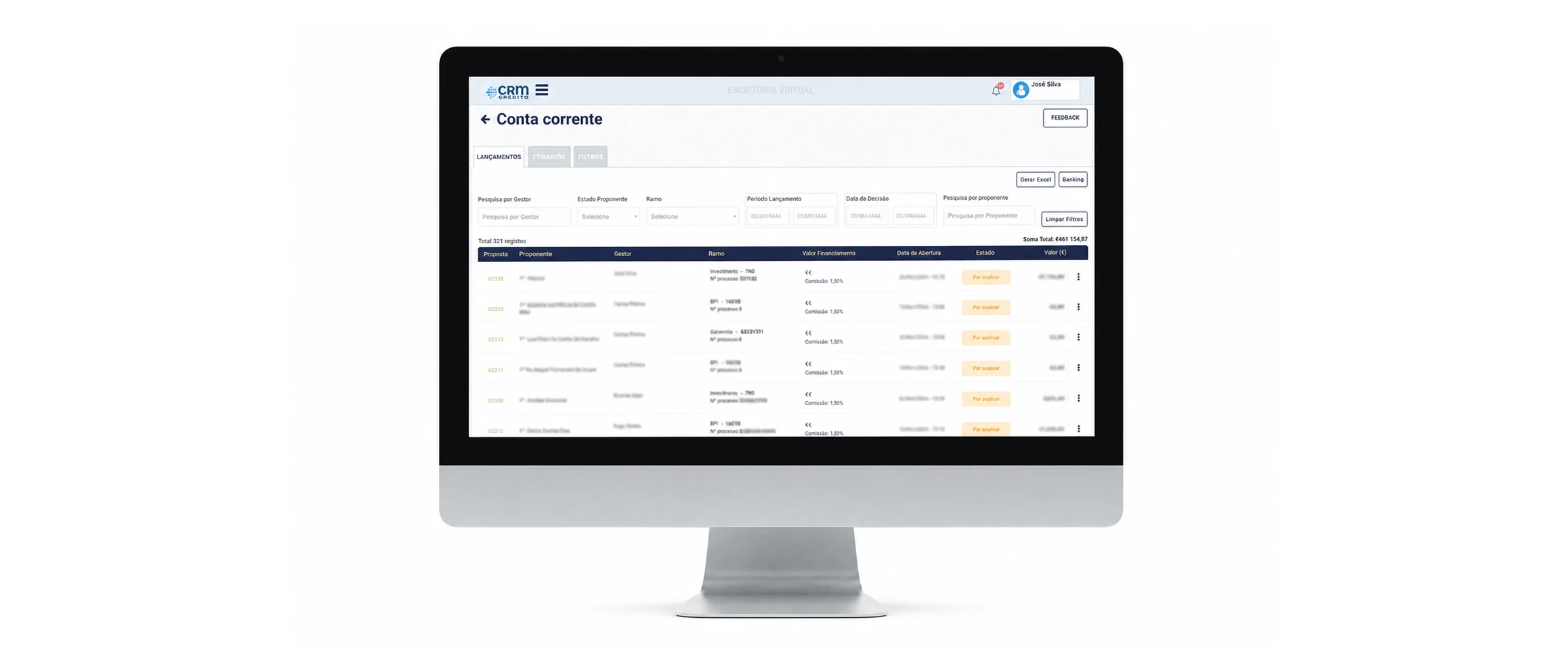
In CRM Crédito, the Current Account area supports the follow-up of entries and commissions. The team can filter information and monitor statuses without relying on several scattered files.
This does not replace accounting or legal review. It does, however, help organise work, reduce repeated tasks and make information easier to consult.
A practical example
Imagine a case that has reached completion. The team records that remuneration is expected and links it to the corresponding case. When confirmation arrives, the status is updated. Once payment is received, the entry is marked as completed.
For internal management, the essential point is that the entry is linked to the right case and can be confirmed by an authorised person.
Good practices for safer control
A few simple rules help prevent confusion:
- use the same statuses across all cases;
- define who may view and change financial information;
- review pending entries regularly;
- avoid unnecessary copies of personal data in exported files;
- compare operational records with accounting information;
- keep supporting documents and agreements accessible only to those who need them.
It is also important to ensure that the remuneration structure does not compromise the duties of diligence, loyalty, discretion and conscientious respect for consumers’ interests.
Frequently asked questions
Who pays the credit intermediary’s commission?
It depends on the category. Tied intermediaries and intermediaries acting in an ancillary capacity are remunerated by lenders. Non-tied intermediaries are remunerated by consumers.
What data should be recorded to track commissions?
Each entry should be linked to its case, lender, status, dates and supporting records. The exact fields depend on the operation and applicable agreements.
Does a CRM replace accounting?
No. The CRM organises operational follow-up. Accounting remains responsible for the relevant accounting and tax treatment.
Does a CRM guarantee compliance with legal rules?
No. A CRM can help organise and consult information, but it does not replace legal review or internal compliance procedures.
Conclusion
Commission control becomes simpler when it is no longer separated from case management. A centralised view helps the team follow what is expected, confirmed or pending and link each entry to the right case.
Visit our page about the CRM for credit intermediaries in Portugal and see how CRM Crédito supports case management, documentation, simulations and current accounts.
Sources
- Banco de Portugal: operating as a credit intermediary
- Decree-Law no. 81-C/2017 of 7 July — consolidated version
Read also
- Credit Intermediation CRM: the best solution for managing cases
- Tied or non-tied credit intermediary: which should you choose?
- Banco de Portugal 2026 guide for credit intermediaries
This content is for information purposes only and does not replace legal or accounting advice.
Ready to get started?
See CRM Crédito in action
Schedule a free demo and discover how the CRM can transform your business.